
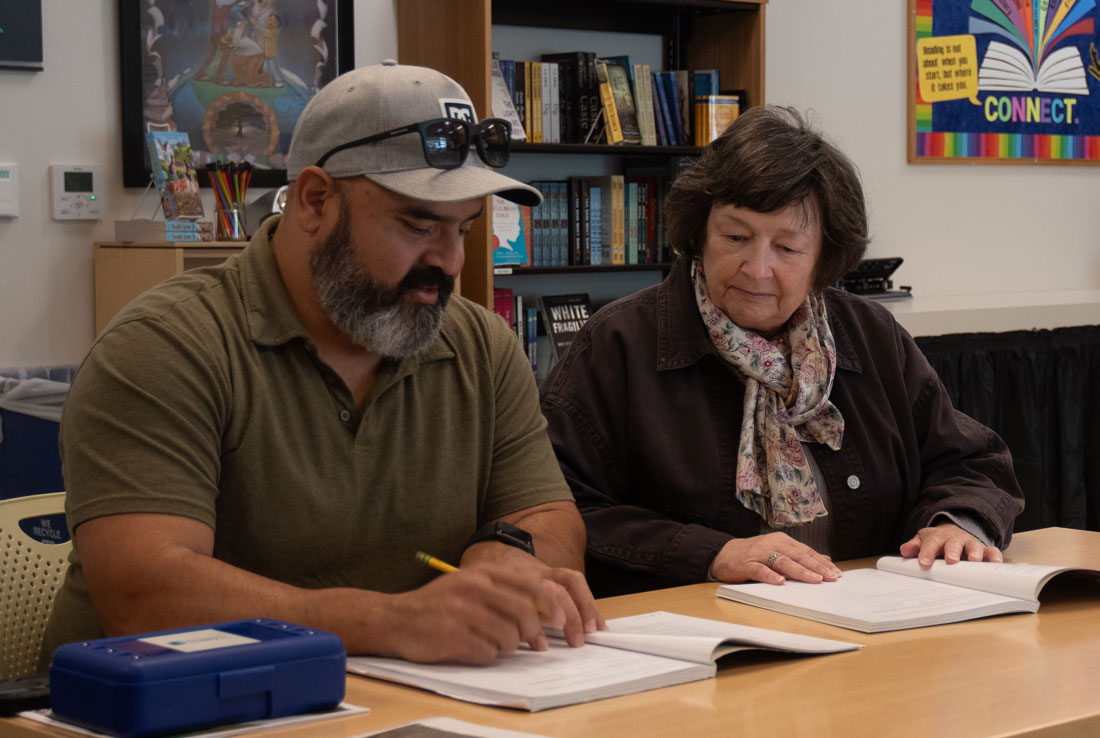
Adults seeking to improve their reading and writing skills through the Santa Clara County Library District’s literacy program in South County are waiting up to six months to be matched with a volunteer tutor, even as similar programs in the northern part of the county have more volunteers than they can use.
The free, one-on-one tutoring program currently serves about 50 matched pairs in Gilroy, Morgan Hill and San Martin, with a waitlist of 15-20 people who have completed their assessments and are ready to begin.
“We have a high need here, with many learners on the waiting list, and we’re working hard to match them with available volunteers,” said Diana Lara, the district’s literacy program manager.
The imbalance is largely a matter of geography, Lara said. North County cities such as San Jose, Sunnyvale and Santa Clara draw from a larger population base, producing a surplus of willing tutors. South County’s smaller communities simply have fewer people to recruit from.
Volunteers face no geographic restriction and may tutor anywhere in the district, which also includes Campbell, Cupertino, Saratoga, Los Altos and Milpitas.
The Gilroy branch holds a distinction within the eight-library county system as the only location with a dedicated literacy center, where tutoring pairs can meet, access materials and borrow books at no cost. All workbooks and instructional resources are free to learners.
“This is where volunteer tutors gather with adult learners who seek to improve their literacy skills and open themselves up to new opportunities,” said Elie Teixeira, a retired teacher and educational administrator who began volunteering at the Gilroy Library about eight months ago.
The program serves adults reading below a ninth-grade level, including both English language learners and native speakers with limited literacy skills. Learners set their own goals at the outset, whether preparing for a citizenship test, helping their children with homework or advancing in the workplace—and a literacy specialist tailors materials accordingly.
For those who complete the wait, the results can be life changing.
Emilio Nuñez, who found the program through a flyer at the Morgan Hill Library, said his tutor helped him discover resources he did not know existed and inspired him to pursue further education.
“If you don’t have those skills, how can you be more resourceful to your community?” Nuñez said. “How can you grow if you can’t communicate?”
Fellow learner Dominga Casas, who waited roughly four months to be matched, said her improved English skills opened up new professional opportunities. Before joining the program, she said, reading was a significant struggle. She now reads books of 200 pages and more.
“English opens doors,” Casas said. “I’ve gained a whole new world of vocabulary. I’m very happy with this program.”
Fiona Warner, who has volunteered with the program for six years and tutors Nuñez, said she researched the program as she approached retirement and completed her training at the start of the COVID-19 pandemic.
“Reading is essential,” Warner said. “Being able to speak English in an English-speaking country is essential just for everyday tasks. I have the time, and it matters.”
To manage the waitlist in the interim, staff have begun grouping assessed learners at similar skill levels into small-group tutoring sessions to help get them started while waiting to be matched with a one-on-one tutor. Virtual tutoring is also available for those who cannot meet in person.
“When our literacy specialists assess learners, they try to group those at similar levels who share the same schedule,” Lara said. “The challenge with group tutoring is finding learners who are at the same level and can meet at the same time. With one-on-one tutoring, scheduling is completely flexible. It’s based on the learner’s and tutor’s individual availability.”
Anyone interested in volunteering can contact the Gilroy Library’s literacy center or visit sccld.org/reading-program. No prior teaching experience is required, but volunteers must be legal adults, read and write at least at a high school level, and complete an orientation and training course.
Tutors are expected to dedicate at least two hours per week to their learner for a minimum of six months, and must prepare their own lessons, though basic materials and resources are provided.
“It’s so fulfilling,” Warner said, reflecting on Nuñez’s growth as a reader under her tutelage. “Every week I go home with a smile on my face. He’s grown into such an open, articulate, thoughtful man, and now he’s giving back to his community. That makes it all worthwhile.”