
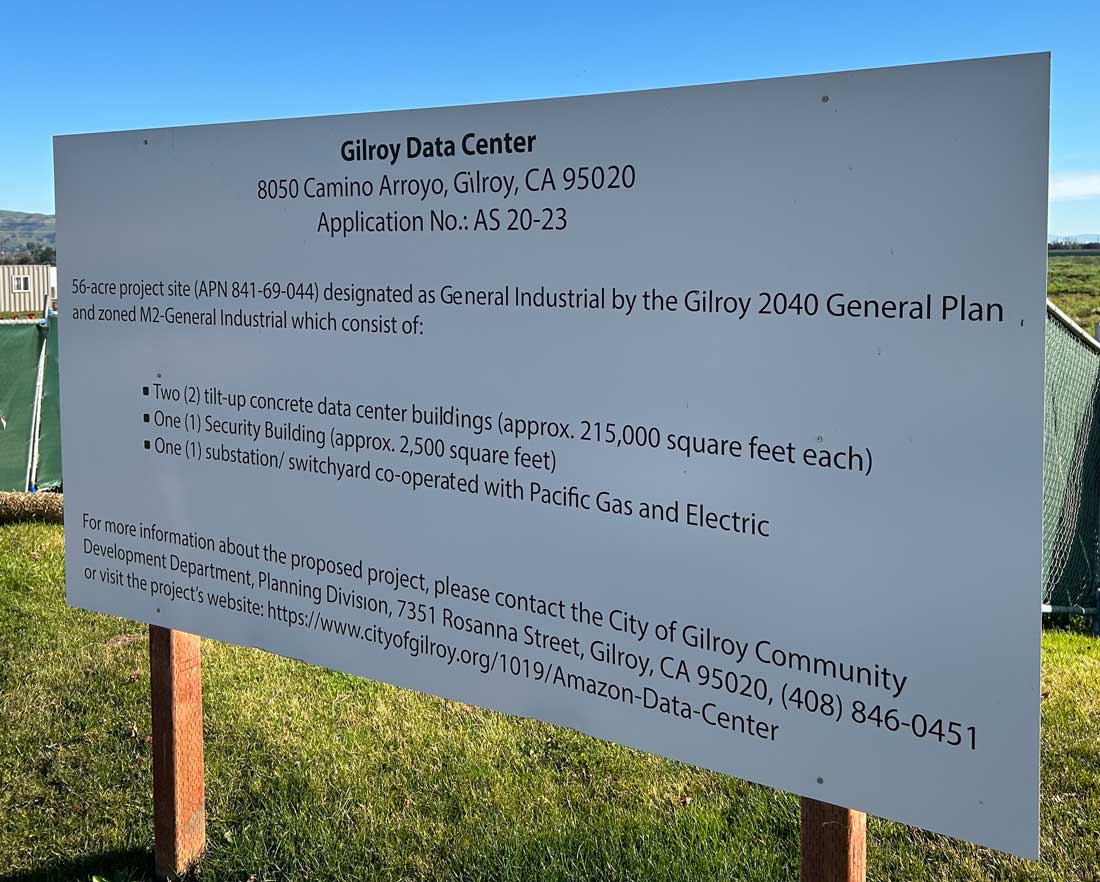
Amazon Web Services will host a public open house June 3 to answer questions and share information about the large data center currently under construction on the southeast end of Arroyo Circle in Gilroy.
Although the project has been approved and obtained permits, it has drawn community concern over water, energy use and the long-term impacts on city infrastructure.
The drop-in event will run from 5-8pm at the Gilroy High School cafeteria and student center, 750 West Tenth St. Representatives from AWS and the City of Gilroy will be available to discuss the project’s environmental review, infrastructure upgrades and operational plans.
According to the city and AWS, the project has completed a full environmental review under the California Environmental Quality Act and was found to meet all applicable standards. City officials said analyses determined Gilroy’s infrastructure, along with upgrades planned as part of the project, can support the facility’s anticipated water and energy demands.
The city said Amazon is constructing infrastructure to deliver recycled water to the site in an effort to “nearly eliminate” long-term reliance on potable water. Air quality studies also found projected emissions would remain below Bay Area Air Quality Management District significance thresholds, according to the review.
Still, the project has become a flashpoint for local activists and residents concerned about the rapid growth of energy-intensive data centers tied to cloud computing and artificial intelligence.
Landon Sepulveda, a lead organizer among residents opposing further data center expansion in Gilroy, said community members hope the June 3 meeting will provide more clarity on several unresolved questions, including how often the facility will rely on potable water before recycled water infrastructure is fully operational.
“(They) previously stated that they will be only cooling (the facility) on the ‘hottest days’ but we didn’t get a concrete number,” Sepulveda said.
Opponents are also seeking confirmation on whether the facility will be used for artificial intelligence operations, details on a proposed second phase of development and contingency plans for future drought conditions.
Other concerns raised by residents include the center’s anticipated electricity demand—estimated by some observers at roughly 98 megawatts—potential utility cost increases, noise impacts and fire risks associated with large-scale lithium battery storage systems similar to those involved in the 2025 Moss Landing battery fire.
“In other states with a large amount of data centers, it’s been recorded that the strain on infrastructure can lead to an increase in prices of utilities, especially if more data centers were to move into Gilroy now that one is being constructed,” Sepulveda said.
The data center project, approved by the city’s community development director in 2025, is planned for an industrial area near the city’s southeast edge. Previous city documents described the facility as part of Amazon’s expanding cloud infrastructure network serving Northern California.
Supporters of the 438,000-square-foot project (on a 56-acre property) have pointed to increased property tax revenue, infrastructure investment and construction-related employment opportunities.
“Amazon has operated data centers in Northern California since 2009 and we’re deliberate about where and how we build,” said Roger Wehner, AWS Vice President for Economic Development. “We see our investment in Gilroy as a long-term commitment to the community, and we take that commitment seriously.”
The June 3 open house is “a chance for Gilroy residents to meet directly with our project team and get answers to the questions they care about most,” he added.
Critics, however, argue the long-term community benefits remain unclear and have called for legally binding agreements limiting expansion and guaranteeing additional oversight.
Sepulveda said his group is advocating for a ban on future data centers in Gilroy and for independent third-party monitoring of environmental and infrastructure impacts. Opponents are also seeking an agreement from Amazon to ensure the project does not expand past its planned Phase 2, “the strain on infrastructure does not lead to spikes in utility bills, and that the data center will not be used for AI,” Sepulveda added.
The organized opponents would also like to see the full buildout of the data center postponed until recycled water infrastructure is in place; and a requirement that a certain portion of data center employees are Gilroy residents, Sepulveda said.
Additional information about the project is available on an AWS project page on the Gilroy Chamber of Commerce website: tinyurl.com/3h736wka.