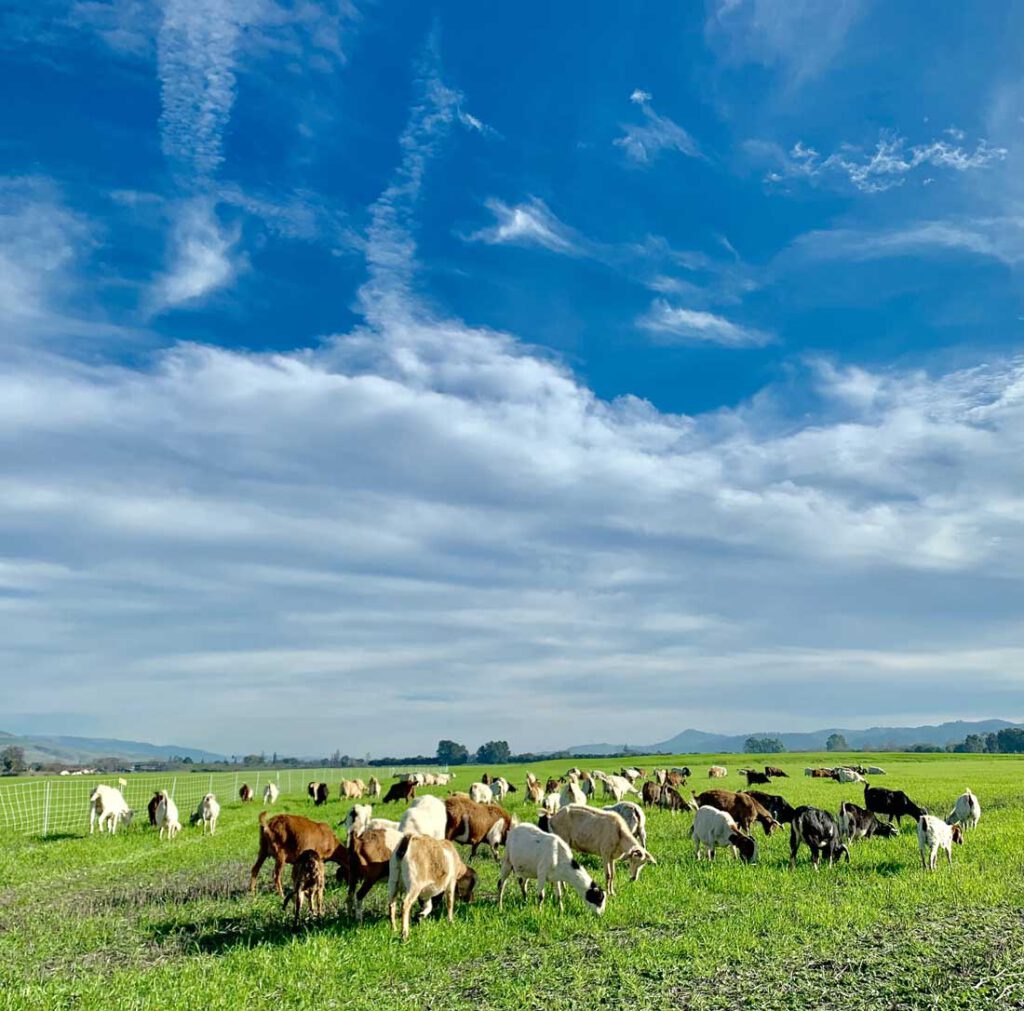

Brian Allen and his son Daniel have built their goat-grazing business, Green Goat Landscapers, from just a pair of animals in 2014 to more than 1,000 goats and sheep today. Contracting with entities including Santa Clara County, the Santa Clara Valley Water District and private landowners across the Bay Area, their goats help to mitigate wildfire risk by clearing brush and weeds safely and organically.
Now, they say a lapsed state wage exemption could put them out of business within the year.
At issue is an expiring State Senate bill that, as of July 1, no longer grants overtime exemptions for goat herders, a change Brian Allen said will now require the company to pay each of its herders more than $240,000 a year—an amount he said no targeted-grazing operation could absorb.
Sheep herders, which were previously given the same treatment as goat herders, continue to enjoy this exemption.
“There is no practical or public safety justification for treating these two industries differently,” the Allens wrote in a July 10 letter to the editor published in the Morgan Hill Times. The Allens warned that the wage gap, left uncorrected, would spell the end for targeting grazing businesses across the state, leaving mowing and pesticides as the only options for wildfire mitigation.
“Our work is in high fire-risk areas, as well as environmentally sensitive areas,” Allen explained. “We’ve done work for San Francisco Airport, as well as Granite Rock, which has a couple of properties over in Santa Cruz, where they have red-legged frogs, as well as some [endangered] salamanders. They can’t mow, and they can’t weed-whack, so their only alternative is grazing.”
The root of the dispute is AB 1066, the Phase-In Overtime for Agricultural Workers Act of 2016, which gradually extended standard overtime rules to farmworkers who had previously been exempt.
For range herders, who live on-site with their herds and are on call around the clock for sometimes weeks or months at a time, this would cause labor costs to become unfeasibly high.
To account for that incompatibility, the act set an alternative minimum monthly wage for herders, but the law named only sheep herders, leaving goat herders in a gray area.
In 2023, lawmakers passed SB 143, which temporarily let goat herders be paid under the same monthly framework as sheep herders.
The temporary fix expired July 1, 2026, with no replacement yet in place. Unless lawmakers act, goat herders will fall under standard agricultural overtime rules, which would require ranchers to pay for all 24 hours of a herder’s on-call day.
In 2025, State Senator Melissa Hurtado introduced SB 801, which sought to permanently resolve the disparity by exempting both sheep and goat herders from AB 1066’s requirements. The bill failed to meet legislative deadlines and died without a vote.
A March report prepared by UC Davis for the Department of Industrial Relations found broad agreement among ranchers, herders and worker advocates that sheep and goat herders should be paid under the same wage framework, since the work substantially overlaps. Where stakeholders diverged was on the wage itself: ranchers argued the current monthly rate is too high, while worker advocates opposed any reduction and instead called for stronger enforcement of existing labor protections.
Green Goat Landscapers, based in Gilroy, employs three H-2A visa workers from Peru through the Western Range Association, which handles the visa paperwork. The company covers herders’ housing, food, cellphones and work gear, on top of wages—expenses Allen said run about $80,000 a year per herder. The rule change could quadruple his labor costs.
“There’s no way” the company would be able to stay in business, he said. “We would have to send our herders home. They’re here on a three-year work contract, so we may have to file bankruptcy because we can’t fulfill their contracts, as well as the contracts that we have with the county” and other entities.
The herd itself would also be at risk, Allen warned. Their 1,000 goats would have to be put up for sale, likely to be slaughtered. The same is true for tens of thousands of other goats belonging to similar outfits across the state, he said.
The company grazes properties from South County up through the Peninsula and into the East Bay from roughly March through November, working land that’s too steep or overgrown for mowing and/or too ecologically sensitive for herbicide spraying, including sites for local water agencies, a rehabilitation facility and properties near residential neighborhoods that need defensible space.
For areas where mowing and pesticides are simply not an option, clients would be forced to pay extraordinarily high rates for targeted grazing. Allen said current rates run from $950 to $2,200 an acre, and that quadrupling labor costs would likely push pricing toward $5,000 an acre, a cost he said many clients, including public agencies, can’t afford.
Allen said he has reached out to state Sen. Dave Cortese and Assemblymember Gail Pellerin, whose 28th District includes Gilroy and South Santa Clara County, in hopes the issue could be addressed through a legislative trailer bill before lawmakers adjourn for the year.
For now, Allen said the uncertainty leaves the company unable to plan past this season. Without a legislative fix, he said, targeted-grazing operations throughout the state would likely have to shut down, resulting in “the loss of more than a decade of hard work, the livelihoods of our employees, and a service that has helped make California’s communities safer.”