


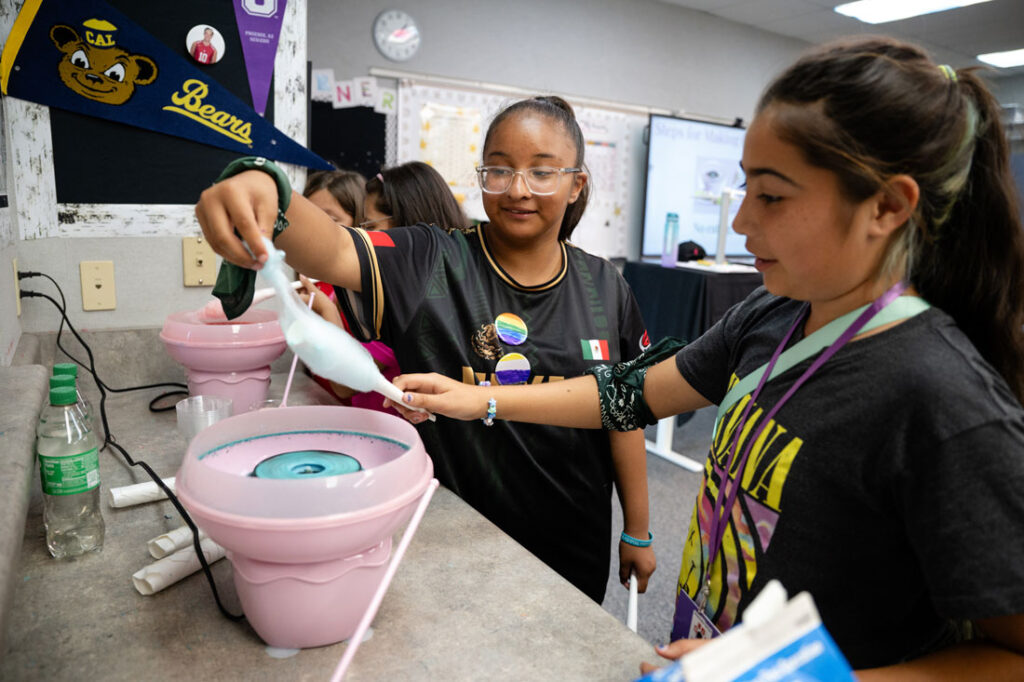
About 150 incoming sixth-grade girls from Gilroy Unified School District took part in Amazon’s Girls’ Tech Day Aug. 11. The event was designed to encourage students to explore science, technology, engineering, arts and mathematics—or STEAM education.
The free, full-day program at Solorsano Middle School featured hands-on activities, interactive workshops and opportunities for students to meet others with similar interests, says a press release from GUSD.
Students rotated through five workshops covering programming and coding, engineering and creative problem-solving, technology and innovation, art and other activities. A petting zoo was also part of the day’s programming.
“Amazon is committed to creating long-term programs in the communities where we live and work, and we’ve made it a priority to help develop the next generation of creative thinkers and future builders,” said Dr. Natasha Martell Jackson, Amazon’s community engagement manager.
GUSD Superintendent Dr. Anisha Munshi welcomed students and encouraged them to consider the range of career opportunities available in STEAM fields.
“You are the leaders of tomorrow, and we want to see you in those positions that you should consider as next generation STEAM experts,” Munshi told the students.
The event marked the third year Amazon has held Girls’ Tech Day in Gilroy. With three middle schools in the district, the event has rotated among campuses, with Solorsano serving as this year’s host.
Jennifer Evans, GUSD’s STEAM coordinator and a former fifth-grade teacher, said the program is particularly important for students preparing to enter middle school.
“We know that middle school is when girls’ interest in math and science begins to wane, as their academic confidence might decrease,” Evans said.
The event provides students with an introduction to potential STEAM careers while encouraging them to maintain their interest and confidence in the fields, she said.
“By bringing Gilroy students together with leaders in engineering, science, math and technology, we can provide role models and encourage girls and young women to envision a future for themselves without limits,” Jackson added.
Girls’ Tech Day is part of Amazon’s broader STEAM education efforts in the Bay Area. The Girls’ Tech Series began in 2018 and has reached more than 20,000 girls and young women ages 8-24 through in-person and virtual events worldwide.
Amazon also launched a $100,000 Gilroy community fund through the nonprofit ChangeX, providing grants to local organizations and individuals working on community projects.










To get anywhere, including rectifying the notably disproportionately low number of male students attending post-secondary or higher education institutions, males need to have the same strong mainstream-media support as females have had for decades, and still do.
Males have observed thus known that they haven’t been taken seriously. If anything, the media are generally cynical toward their cause.
When I communicated with a metro-daily newspaper editor about boys’ school-grade averages considerably falling yet basically being ignored by our governments and sociology/education academia — and generally dismissed by the mainstream news-media — she made a sarcastic reference to the males as “the poor little boys”.
Her attitude clearly rang with incredulity, that males can’t really be a social/societal victim.
In his book The Highly Sensitive Man (2019, Ch.1), author and psychologist/psychotherapist Tom Falkenstein writes that there are “numerous psychological studies over the last forty years that tell us that, despite huge social change, the stereotypical image of the ‘strong man’ is still firmly with us at all ages, in all ethnic groups, and among all socio-economic backgrounds. …
“You only have to open a magazine or newspaper, turn on your TV, or open your browser to discover an ever-growing interest in stories about being a father, being a man, or how to balance a career with a family. Many of these articles have started talking about an apparent ‘crisis of masculinity’.
“The headlines for these articles attempt to address male identity, but often fall into the trap of sounding ironic and sometimes even sarcastic and critical. They all seem to agree to some extent that there is a crisis.
“But reading these articles one gets the impression that no one really knows how to even start dealing with the problem, let alone what a solution to it might look like. One also gets the impression from these articles that we need to keep any genuine sympathy for these ‘poor men’ in check: the patriarchy is still just too dominant to allow ourselves that luxury.”