

A federal judge has granted a preliminary injunction halting construction of a proposed U.S. Immigration and Customs Enforcement facility near Gilroy, a ruling county officials and community advocates celebrated Sept. 14 as a major, if not final, victory in a four-month legal fight.
U.S. District Court Judge Eumi K. Lee issued the order late Sept. 11, continuing to block work at 7240 Holsclaw Road in unincorporated Santa Clara County, where the federal government has been pursuing development of an ICE enforcement and removal operations facility without completing a required environmental review or consulting state and local governments, county officials said.
The ruling came after a hearing Sept. 8, when Lee had extended a temporary halt on construction at the Holsclaw Road site to allow further review of the injunction request.
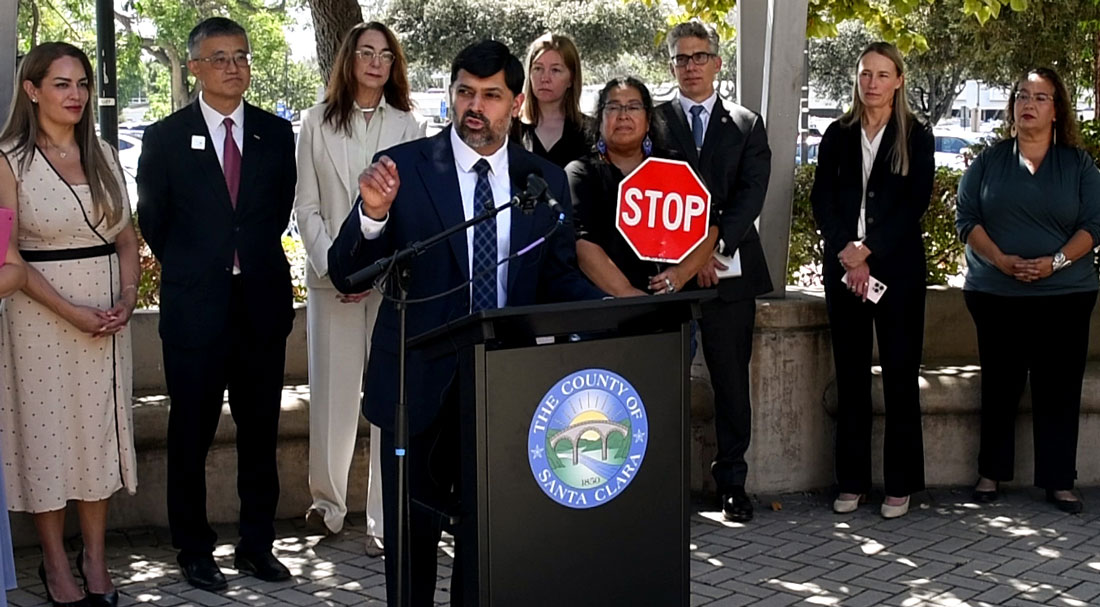
“We’re proud to announce today that the federal district court issued a preliminary injunction late Friday night, halting the project,” Santa Clara County Counsel Tony LoPresti said at a Sept. 14 press conference outside the county government center in San Jose. “The court’s ruling is clear and unmistakable: the federal government failed to follow the National Environmental Policy Act when it attempted to move forward with this project without carrying out any kind of meaningful environmental review.”
LoPresti said the evidence developed during litigation showed the planned use could overwhelm the site’s existing septic system, which was designed for a different, less intensive use, and that hazardous materials on the property posed a risk to human health, the environment and endangered species in the surrounding habitat.
He said the federal government “tried to sneak this project by with a one-page form” claiming a categorical exemption from NEPA review.
“It’s our view that the federal government should cut its losses and walk away from this project,” LoPresti said. “But if they don’t, we are ready, willing and able to continue pressing this case in court, and we’re confident we’ll continue to prevail.”
Rebeca Armendariz, chair of the ICE Out of the Gilroy Coalition and a fourth-generation Gilroy resident, credited monthslong community organizing with forcing the issue into the open. The coalition of local advocacy groups organized marches, vigils and other demonstrations drawing residents from across the Bay Area to come together in opposition to the project.
“The Department of Homeland Security thought it could quickly and quietly construct a brand-new holding facility in our community,” Armendariz said. “What it got instead was quick action from the state of California and Santa Clara County to stop it in its tracks.”
Armendariz said the injunction was not the end of the fight and urged supporters to stay engaged through local rapid response networks and groups including the Community Agency for Resources, Advocacy and Services (CARAS) and Services, Immigrant Rights and Education Network (SIREN).
“Today, we can celebrate,” she said. “Tomorrow, we get back to work.”
Morgan Hill Unified School District Superintendent Dr. Carmen Garcia said the threat of the facility has taken a measurable toll on students. She said families in her district have experienced deportations and forced separations, and that educators have increasingly taken on the role of connecting students to services like rental assistance and mental health support.
“When our community is shadowed by the threat of a detention center, mass deportations and forced family separations, our students do not come to school ready to learn,” Garcia said. “They come carrying an invisible backpack of terror. Its contents are not books and supplies, but chronic anxiety, severe hypervigilance and toxic stress.”
County Supervisor Sylvia Arenas, whose District 1 includes part of South County, told the crowd that “no one is above the law, not even the federal government.”
“In their haste to hurt immigrant families, this project was pushed forward without environmental reviews,” Arenas said.
She paraphrased Justice Lee, saying, “They [the defendant] offer no proof that they conducted a meaningful environmental analysis before starting construction. She also said the record is devoid of evidence that the federal defendants engaged in any reasoned decision-making.”
District 2 Supervisor Betty Duong said the win belonged to the community members and advocates who first raised the alarm about the project months ago.
“We would not be sitting here today without community,” Duong said. “Community members know things government doesn’t know. They see things before we see them, they feel the impact first.”
County Executive James R. Williams closed the prepared remarks by framing the outcome as the product of years of investment in the county’s legal and community partnerships, rather than a one-off win.
“Our success here, preliminary though it may be, is not the result of chance or happenstance,” Williams said. “It’s the result of hard work, and also thoughtful, strategic investment over a long period of time.”









I am laughing at these legally deficient leaders. The Judge knows the best he can do is delay construction. The ICE facility will be built eventually. The leader are most likely using this to detract you away from high gas prices, higher food prices, lack of affordable housing, clean water, and a community that is not welcoming because of poor landscaping with trash everywhere and with terrible city roads. Remember this when you vote this November. I know I will!
Ken Levonius