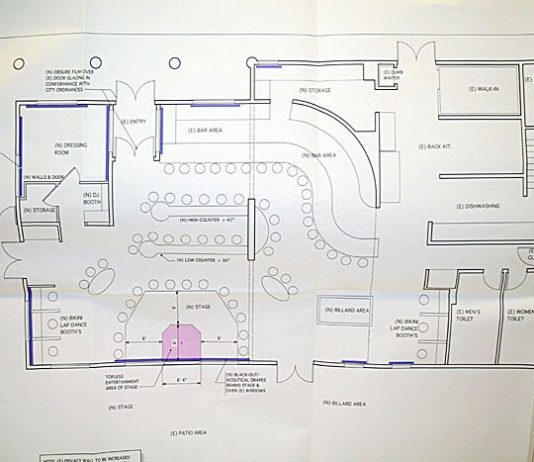

Confusion and confidentiality agreements surrounds closed sessions
Council debates what exactly is off-limits to reporting
Planners approve 202-unit townhouse project
A property developer and city staff disagreed pointedly at a Planning Commission meeting Dec. 3 over the fairness of requiring the company to rebuild seven intersections around its planned townhouse complex in southwest Gilroy.The Planning Commission passed the requirement as part of a package of resolutions approving the construction of Imwalle Properties’ 202-unit complex. The company must install traffic signals and add lanes to intersections to accommodate increased traffic expected in the area as a result of the project.The city estimated the development’s traffic impact not in isolation but in combination with those of other projects in progress in the area, including the Hecker Pass and Glen Loma developments.“We’re one of all the projects coming into the southwest quadrant of Gilroy, and yet we’re being asked to fix all these intersections and pave the yellow-brick road for all the new projects coming in,” said lead developer John Razumich. “It’s a bit of a challenge for us.”Building the improvements would add $7 million before reimbursement to the cost of the project and extend it by three to four years, Razumich said. It is difficult for a smaller company like Imwalle Properties to find financing for the extra cost, he said.City planners had previously proposed charging the company only for its share of the construction cost and improving the intersections itself, in accordance with a study prepared by consulting firm RBF. However, commissioners questioned whether the report adequately estimated the project’s effect on traffic in the area, so planning staff hired another firm to conduct a second traffic study.The second study, by Hexagon Consulting, essentially agreed with the first but recommended that the developer build the improvements. Imwalle Properties would be reimbursed for its construction, minus its fair share.The developers did not dispute the necessity of the improvements but rather the fairness of having to construct them on their own. The obligation imposes an almost impossible financial burden that is out of proportion with the amount of new traffic caused by their development, Razumich said.“Our impact came out the same, but what has changed is we’ve gone from paying $1.6 million and doing the work adjacent and near to our site to needing to fix intersections that are over four miles away that are under state jurisdiction, that are under county jurisdiction, that we’re simply not set up for, we’re simply not capable of.”Collecting impact fees would not be adequate to cover the cost of building the improvements, said Kristi Abrams, the city’s chief planner. Improvements are needed to compensate for the cumulative effects of surrounding projects expected to open in the future, she said. Since the developers for those projects pay their contributions at different times depending on when they are approved, the fund does not contain all the money needed to finance improvements for cumulative impacts.“If the applicant does not mitigate their impacts, paying a fair share does not mitigate the impacts because it does not get the improvement complete,” Abrams said.The traffic-impact fund is currently running a deficit, Abrams said. Revenue fell below liabilities during the Great Recession, when applications stopped coming in.Abrams said the developers misunderstood the nature of the impact fund. Impact fees are collected to cover improvements for traffic increases throughout the city, so a project’s impact cannot be effectively calculated for individual intersections, she said.“There are all kinds of trips throughout the city that are just not at that location they’re identifying,” Abrams said. “If you wanted to follow their philosophy, then you would need to figure out where those trips are all day, every day, seven days a week and figure out all those little percentages throughout the entire city. So that kind of analysis doesn’t work for the city of Gilroy.”The city council’s final vote on the project has not yet been scheduled. Imwalle Properties will continue to discuss how to complete the improvements with city staff and city council members before then.
Pot shop win ignites city ire
A Superior Court judge handed down a divisive ruling Tuesday
City needs volunteers to fill boards, commissions, committees
The City of Gilroy is looking for volunteers to fill 27 open seats on 13 different City boards, commissions and committees, according to City Clerk Shawna Freels. From the Arts and Culture Commission to the Open Government Commission to the Planning Commission, most positions have a term between two and four years of service.
Drones and Street Calming at Council
Drones may be at the top of many holiday wish lists this year, but rules governing their recreational use in Gilroy are still being determined.On Nov. 21, the City Council directed staff to prepare an ordinance regulating drones—or unmanned aerial vehicles, as they are officially called, after hearing examples of rules applied in other California cities. Currently, the only statewide laws apply to drone usage around the scene of an emergency.The Gilroy Police Department has received calls from residents about drones invading people’s privacy and flying at night or during early morning hours, causing disruptions. An ordinance would give police an enforcement mechanism to take action and issue citations when they receive complaints.GPD Captain Kurt Svardal told the council the department looked at Los Angeles, Santa Clara and Ripon to see if any of their ordinances could apply to Gilroy.The staff report recommended the city apply some of the rules from Los Angeles, declaring it a “middle of the road approach.”A Dispatch poll found that about half of respondents wanted to ban drones outright, but the police and City Council did not feel this was necessary.“We are not proposing an all-out ban,” said Mayor-elect Roland Velasco. “We are trying to come up with a compromise that allows hobbyists to get out there, but also protects the privacy of neighborhood residents in the area.”The council suggested the ordinance include rules governing time of flight—sunup to sundown; and that the drone must remain within the line of sight of the operator. It would also include exemptions for public safety uses by law enforcement or other emergency responders. Traffic calming for Upper Welburn After several community meetings between public works staff and a neighborhood group consisting of 37 residences in the Upper Welburn Avenue area between Santa Teresa Boulevard and Mantelli Drive, as well as a presentation by the group at its Oct. 17 meeting, the City Council approved $25,000 to be spent on temporary “soft” traffic calming measures and follow-up monitoring to address various traffic issues in the area. They include installation of “No Right Turn” signs along southbound Mantelli just before the intersection with Welburn and a temporary plastic delineator barrier at the western entrance of Welburn at Mantelli, with “Do Not Enter” signs and a reflective marker yellow centerline stripe on upper Welburn. Staff will also discuss student drop-off at the nearby Pacific Point Christian School, which residents say cause much of the congestion.
Webinar about VTA’s Transit Redesign in Morgan Hill and Gilroy
This webinar lets you see in real time the changes VTA is planning for Gilroy and Morgan Hill.
Drop off your ballot this weekend
The Santa Clara County Registrar of Voters is encouraging voters to drop off their ballots this weekend so they can get to counting the votes in time for Tuesday night.