
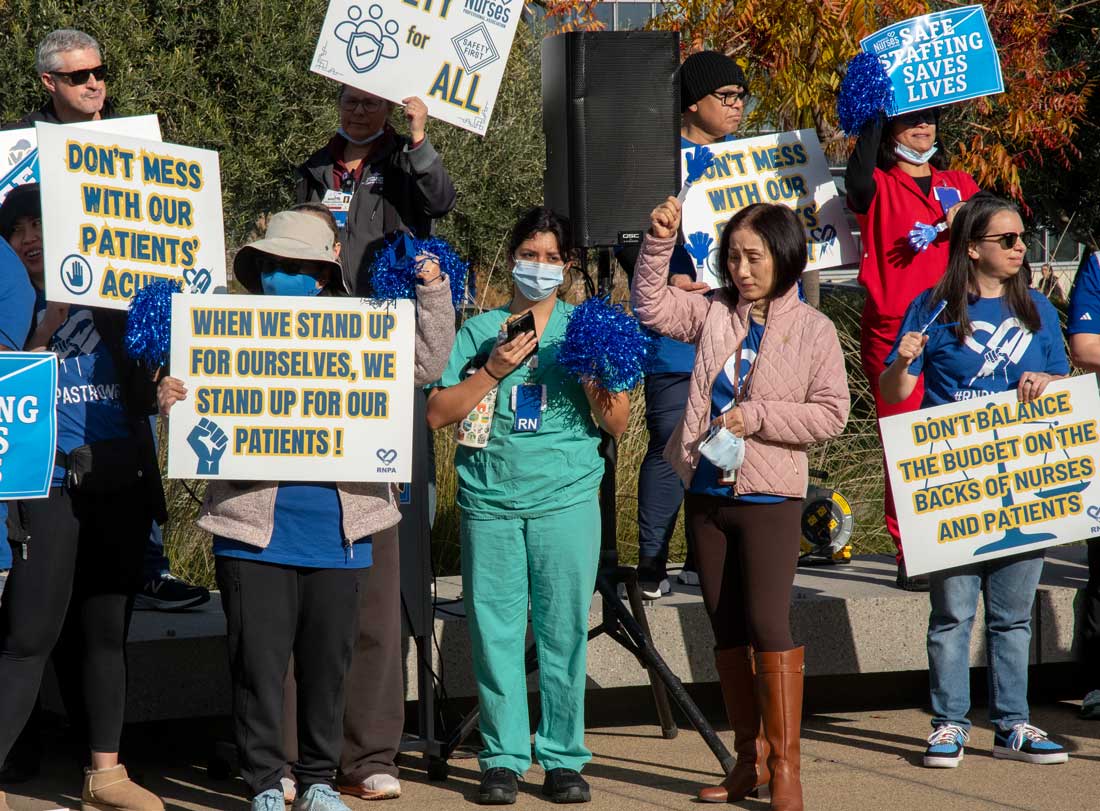
Hundreds of registered nurses gathered Dec. 16 outside four Santa Clara County hospitals to protest what they describe as dangerous staffing cuts that threaten patient safety across the countywide hospital system.
The rally, organized by the Registered Nurses Professional Association, brought together nurses from multiple county facilities who say budget driven staffing reductions are forcing them to work under conditions incompatible with safe patient care, including within the Custody Health department, which deals with incarcerated patients.
“Our leadership at Custody Health is failing us and failing our patients,” said Vanessa Harris, a Custody Health nurse at the Santa Clara Valley Medical Center, during the rally at the San Jose hospital. “They keep adding new tasks to satisfy federal monitors while cutting staff. It is unrealistic, unsafe and irresponsible.”
Harris said nurses who speak up about safety risks or advocate for better staffing face retaliation and silencing, creating an environment where many nurses are afraid to report unsafe conditions.
The nurses—who held a similar rally earlier Tuesday at Saint Louise Regional Hospital in Gilroy—cited multiple concerns affecting patient care including unfilled support positions, furloughs, denied breaks and overtime, excessive patient loads and pressure not to document safety incidents. They say more than 200 nursing positions remain frozen while administrators consider hiring travel nurses.
Allan Kamara, a trauma nurse and incoming 2026 RNPA president, called on county leadership, including County Executive James R. Williams, to release the frozen positions to provide relief for overworked nurses.
“There are over 200 positions that are frozen right now,” Kamara said. “We are pleading to James Williams … we are pleading to you that you release this code so our nurses can get more staffing at the bedside, so our nurses can be able to take care of the community without worrying about who’s going to cover my break.”
Williams did not respond to a request for comment.
The protest comes as the county health system faces unprecedented budget cuts as the federal government slashes funding from Medicaid, the primary funding source for the county health system, resulting in a loss of revenue of more than $1 billion.
In November, county voters passed Measure A to shore up some of that loss, but the measure only offsets the reduction by about $330 million annually, forcing officials to make deep cuts to services.
“We passed Measure A in Santa Clara County because this community believed in public health and safe care,” said Christina Acosta, a Custody Health nurse at Valley Med. “Yet here we are: still understaffed, overworked, facing furloughs, while layers of administration continue to grow and bedside care continues to shrink.”
Kamara also addressed workplace violence, saying nurses are being assaulted at work with alarming frequency. Instead of receiving support, he said, nurses are asked what they could have done differently and offered self-defense classes.
“When nurses are assaulted at work, we cannot accept that. We cannot normalize that,” Kamara said, calling on the county to hire more public safety officers and provide deputy sheriffs to protect healthcare workers.
Ed Solis, a Gilroy resident and patient advocate who survived a heart attack nearly two years ago, spoke about the care he received at O’Connor Hospital’s ICU. He spoke highly of the care he received from O’Connor’s nursing staff who saved his life.
“Every time those nurses came in to draw my blood, every time they came in to check my vitals, every time they came in to just make sure that I was conscious and awake, they reassured me,” Solis said. “They said, ‘I got you. Don’t worry about it. We’re going to take the best care of you as we can, Ed.’ And I went from thinking ‘I’m going to die’ to ‘I’m going to be okay.’”
A former manager and city employee, Solis said he is no stranger to making difficult budget cuts, but that slashing frontline workers like nurses does more harm than good.
“Cutting our frontline workers, our forward-facing employees, is the worst thing you can do as an organization,” he said. “They are the lifeline, the lifeblood of our organization. And when they’re struggling, the organization struggles—not at the top, not in the middle. It’s the frontline employees who are taking care of our most needy.”
RNPA President Suzie York said the association will continue demanding real investment in staffing.
“Do not balance the budget on the nurses’ backs,” York said. “Safe staffing saves lives.”