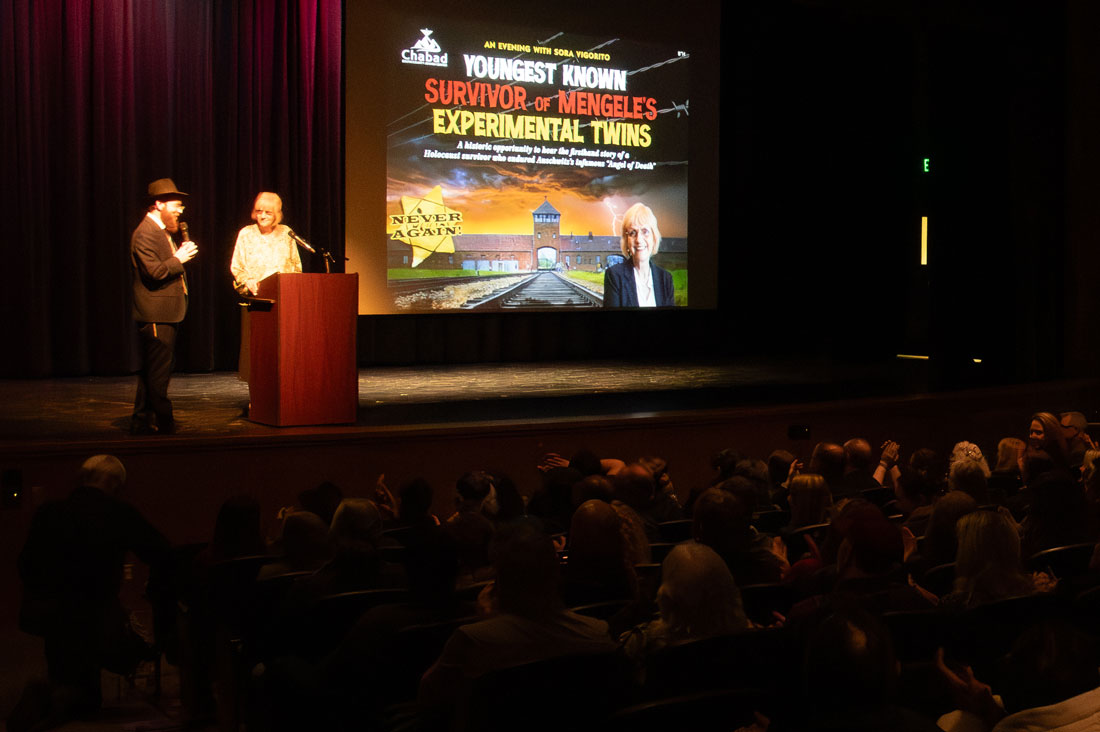
Sora Vigorito was 3 years old when she and her twin sister were pulled from their grandmother’s arms at the gates of Auschwitz and handed to the infamous Nazi physician Josef Mengele. More than 80 years later, she stood before a packed auditorium at Live Oak High School in Morgan Hill and told that story herself.
Vigorito, believed to be the youngest known living survivor of Mengele’s experiments, spoke on Feb. 23 to hundreds of community members at an event organized by the Chabad South County Jewish Center. Vigorito’s appearance offered a rare opportunity to hear a firsthand account from the shrinking generation of Holocaust survivors.
Vigorito, who was born in Berlin in 1941, recounted hiding as an infant in a basement in Dessau, Germany, with her twin sister, Hanna, and their grandmother. The pair never saw sunlight, never played with other children and kept silent against the threat of Nazi patrols above.
“My grandmother told us that we were rats,” Vigorito recalled. “The people with black boots and shiny buttons on their uniforms, they were cats. And cats hunt rats.”
She described the day uniformed men discovered them and forced them into a cattle car bound for Auschwitz-Birkenau, and the moment at the camp’s entrance when Mengele spotted the twins and separated them from their grandmother.
“We screamed in vain as we were taken away from our baba,” Vigorito said. “She stood there pleading, tears in her eyes.”
Mengele subjected the twins to a litany of experiments, which ranged from injections, to bone scrapings, to applying caustic substances to their skin—the burn scars from which Vigorito carries to this day. Mengele’s aim was ostensibly to learn what causes a mother to bear twins, in order to use that knowledge to multiply the ideal German population.
Hanna died from the effects of Mengele’s heinous experiments. When Mengele came to remove her sister’s body from their cage, Vigorito, then about age 3, struck him in the face. He responded by smashing the fingers of her right hand with a hard instrument. The damage required extensive surgery years later to restore her hand to normal function.
“The physical things are gone,” Vigorito said. “The scars are there, but they don’t hurt anymore. The spiritual impact, that is a different matter.”
After the camp was finally liberated by Soviet forces in January 1945, Vigorito recovered in Poland. Her grandmother, remarkably, survived Auschwitz, and the two were reunited shortly after the war.
Vigorito’s path after liberation took her through East Germany to the West, escaping across the Iron Curtain by sneaking through tall grass, later to rural Canada, and finally the United States, where she met her husband, Frank Vigorito, and began raising a family that would yield nine grandchildren to date.
She later earned a master’s degree in religious education from Gannon University and worked as a licensed mental health professional, drawing on her own experience to help clients navigate trauma. She is also the executive producer of an Emmy Award-winning documentary film about her life, produced by Kent State University.
Among the audience at the Feb. 23 talk was Santa Clara County District Attorney Jeff Rosen, whose father survived the Bergen-Belsen concentration camp before immigrating to the U.S. in 1950. Rosen drew a connection between his and Vigorito’s shared family history and his work as a prosecutor.
“There was no justice for my family or the Jewish people,” Rosen said, addressing the audience before Vigorito’s talk. “One of the things I see in my role as district attorney is to provide justice for victims of crime, and to send a very strong message that this is a community where everyone is entitled to equal, fair, and respectful treatment under the law.”
Morgan Hill Mayor Mark Turner also addressed the crowd, calling Vigorito’s willingness to speak publicly “an act of courage that ensures these stories are never lost to time or indifference.”
Vigorito closed her remarks by reflecting on a decades-long spiritual journey that eventually brought her back to Jewish practice after many long years of religious apathy.
“The numbness began to melt, though the pain remained,” she said. “It didn’t erase the loss of my sister, but it reminded me that my neshama, my soul, was still alive. From that moment on, my life became more than just surviving. It became about living, and rebuilding, and sharing my story. Even after the worst losses, renewal is possible.”