




Electricity shorts out in Tank as Sharks go down 3-1
Monday started with a roar and ended with a whimper.
Stanley Cup Final: Sharks fall into 3-1 hole

SAN JOSE - San Jose finds itself trailing 3-1 in games after dropping a 3-1 decision to the visiting Pittsburgh Penguins Monday at sold-out SAP Center.
Nils Myers and Mattie Scariot
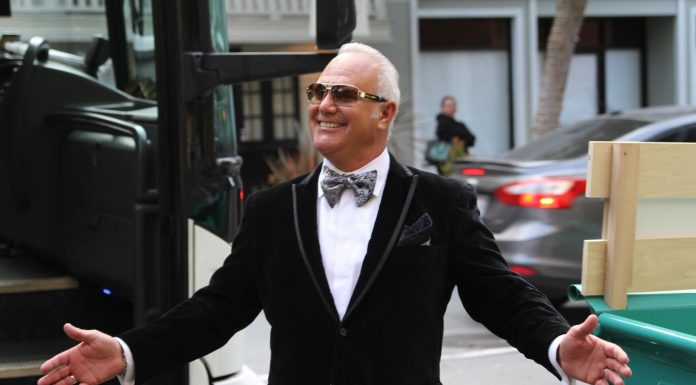
Husband and wife Nils Myers and Mattie Scariot spent days and nights editing The Biggest Game in Town which they produced along with John Nava.
‘The Biggest Game in Town’ Gilroy Movie Premiered Saturday

Director John Nava knows his way around poker tables. He once sat at one with a chef, a Mafia boss, an Elvis impersonator and a Stanford student and he put all his money in on one bet. He lost.The Stanford student who won got up and thanked him for paying for her textbooks for the year, cashed in her chips and left. His misfortune led Nava, who has worked at Sigona’s Farmers Market in Redwood City and Palo Alto for 37 years, to write the script for The Biggest Game in Town about a bunch of colorful poker players trying to defeat the best player in the country with every cent they could muster—and more—on the table.Nava pitched it to Gilroyans L. Mattock Scariot and her husband, Nils Myers, whose 152 West Productions has made corporate and children’s movies for the past decade. They loved it, and the trio, all in their 50s, went all in on their biggest dream, devoting two and a half years of weekends and $30,000 of Nava's money into making it.From the applause and howls of laughter during its debut Saturday at Monterey’s Golden State Theater, this time Nava won. They sold more than 600 tickets at $30 each and got it viewed by buyers from some big film festivals.“In a way, everybody who’s in this movie is the biggest game,” said Nava, who was raised in Morgan Hill and lives in Hollister. “We’re an indie film that cost $30,000 and we’re going to festivals competing against movies that are going to be $200,000 to $1 million. We’re real indie and everybody who was in it donated their time and no one got paid.”In keeping with the poker theme, Nava bought the camera used for the film with winnings from a poker game a week before shooting began. He In his off time working in produce, Nava, a film devotee who made the western Handsome Stranger 22 years ago, created demo reels for aspiring Hollywood actors in San Francisco. He would write and direct the clips and each of them got jobs. One of them, Eric Zivot, who played in an episode of the TV show Jag and was in movies, Mob Story in 1989 and The Alarmist and Two Voices in 1997, returned to the Bay Area to take a leading role in The Biggest Game.The other actors are locals who perform like seasoned pros in the movie. Morgan Hill’s Steve Caposio is a natural ham who showed his bacon as the winner of Food Network’s Cutthroat Kitchen earlier this year. The movie’s lead, Jayson Stebbins, is simply stunning. He’s a Morgan Hill mortgage broker with a lot of local community theater experience, who comes off as an everyman schlub with million-dollar dreams and 10 cents to his name. He is like a mix of Vince Vaughn and Ben Stiller.Joe Barra, who played the casino manager, was an insurance broker for State Farm, and died before the movie came out. An accomplished theater actor, his dream was to make a movie, and he did. Nava paid tribute to him during the premiere.When Scariot told the audience at the premiere that she wouldn’t choose Hollywood’s best over the actors they had, you can believe it. Although you could also see this script, with its wry, dark humor, being picked up by Hollywood and brought to the cineplexes everywhere. The movie has the wackiness of The Hangover with some of the tension of Ocean’s 11. That’s no surprise given that Nava’s two favorite movies are The Wizard of Oz and the Godfather. He has allusions to both in this.The decision to risk it all on a dream resonated with Scariot when she read Nava’s script. Its lead character, Atticus Cane, is a disappointed, but hopeful, 40-something on a quest to compete in a legendary poker game started by the “original Texas gamblers,” spoken to him in reverent tones over the years by older pal, Manfrotto.Many poker nights with the guys later, the desire to play at this high-stakes game, with a $100,000 buy-in becomes an obsession for Atticus, consuming both his waking hours and subconscious.“Everyone in the film is Atticus—we are all in our 40s and 50s—and we all have that dream of making it in Hollywood, so I felt really tied to that character,” Scariot says. “I think most middle-aged people feel that at one point in your life, you say: ‘I just have to take a risk, I’ve just got to do it. I’ve got to just put it out there and see what happens.’”Nava says the bedroom conversations between Atticus and his wife about chasing the big time poker dream echo the ones he’s had with his own wife about chasing his dream of making films.Reviews from those leaving the premiere, which included food and a band with an Elvis impersonator, were positive.“It’s exciting to have Gilroy folks actively involved in the arts and putting something together,” said Gilroy City Council member Roland Velasco. “There’s a lot of Gilroy people here that came to show their support.” While he only plays poker himself every once in awhile, Velasco said it was “fun to watch the dynamics between people—and that is what you saw in the film.”Robert and Sarah Caposio, the son and daughter-in-law of one of the film’s highlights, the irascible, “Diamond Dave,” were ecstatic after the film. “We thought the movie was hilarious,” said Robert. “I was laughing the entire time.”Sam Bozzo, longtime community supporter and member of the advisory board of Pinnacle Bank, gave it a thumbs up. “What a wonderful undertaking and there was such a cross-section of people involved,” he said. Steve Caposio chartered a bus to bring friends and family to the premiere.South Valley residents worked for free and donated locations to the movie. Fox Creek Ranch in Hollister let the crew film a western dream sequence there. While others were asking $25,000 to write a score, San Jose musician David Santos traded two months of work for fruit and cheese. Morgan Hill developer Frank Leal donated locations and helped feed the crew.Artist Heather Apgar, 17, made one of the movie’s posters. The other was made by Ralph Noe, who also plays witness protection killer Vic Manfrotto.“This is really a case of a community coming together and sharing everything they have to make a movie,” said Nava, who spent three hours of his “glamorous” day after the debut cleaning the theater, while other cast and crew were at a party.“That’s the other side no one sees,” he said. “After the show everyone leaves and it looks glamorous, but we have to stay and clean the trash.”Scariot and Myers of 152 West Productions have made a name for themselves with professional and inspiring corporate videos for the likes of Sigona’s Farmers Market, Jabil Trinidad, Dental Concepts and Cal State University.They met in Southern California, where Myers was a film student and Scariot a costume designer. When they had children, they decided to move back to Gilroy, where Scariot was raised. The kids are grown now and her son, who works at the House of Bagels, has a sandwich named for him. Scariot is also on the city’s arts commission and has been working to grow the Gilroy Arts Center. They also run a summer program that teaches kids how to make movies.While hitting the big time with the film would mean Hollywood, said Scariot, an invitation to appear at a film festival or a good placement on a streaming service like Hulu or Amazon, would also be terrific.“The key is to get placement in the front of streaming services like Amazon, Netflix, Hulu. [Otherwise] it can just disappear,” she said. “If we go to film festivals and win awards they would market it better and get that better placement.”There is also hope that if The Biggest Game in Town wins enough favorable exposure, distributors would be interested in 152 West’s previous titles. Currently one of their films has an agent and is distributed overseas.“It would be great to be in the theaters,” she said. “That would be winning the biggest game in town.”
RED PHONE: Street Racing on Santa Teresa

There’s a growing problem with evening and night street racing on Santa Teresa, from around First Street north toward Christopher High. Usually beginning at 10 p.m. or so, the noise from Santa Teresa becomes ridiculous: squealing tires, loud music, shouting (between “contestants”?) and engine revving as they wait for the green light at Mantelli that seems to be the starting line. Our property backs up to Santa Teresa and we’re accustomed to the normal traffic sounds, which are bearable. This racing though is so loud and so potentially disastrous that something needs to be done. There were even large circular “doughnut” tire marks noted one morning a couple weeks ago at the corner of Mantelli and Poplar. I filed a non-emergency police report about this several months ago, but the races continue. One of these days, this is going to lead to tragedy. Anything you can do to help will be appreciated by all in the neighborhood, as well as pedestrians and passing motorists.
Do new schools matter?
In mailers to thousands to Gilroy homes, in speeches, in endorsements by politicians and wealthy businessmen and on signs all around town, voters have been told that passage of the $170 million Measure E bond proposal on Tuesday’s ballot will ensure Gilroy kids get a good education by building modern schools with state-of-the-art technology.But a Dispatch review of school rankings and research data suggest the jury is still out on whether new facilities make a significant difference in some measures of academic standards.In Gilroy, school rankings appear inconsistent on the question and suggest that factors such as poverty play a bigger role than facilities when it comes to classroom achievement.Christopher High School, the district’s $158 million showcase, was built with 2008 bond money and non-voter approved $33 million in Certificates of Participation, repaid from the general fund. Its state academic ratings are high, 8 out of 10 compared to all California high schools and 7 among schools with similar demographics.But Gilroy High School, an old facility with some recent modernization, ranks at 4 among all high schools and 5 among similar schools in the state.Glen View Elementary School was completely remodeled last year with about $7 million from 2008’s $150 million Measure P, money still being repaid by taxpayers.Glen View in the past has lagged in test scores and in recent tests that pattern continues. The school ranked 4 on a scale of 1 to 10 compared to schools statewide.Compared to schools with similar demographics it ranked 3. And in terms of how it serves low-income students, who make up most of its student body, it also ranked at 3.Gilroy Prep School, the only charter school in the Gilroy Unified School District, ranked at 10 among California schools, 9 in how it helps low-income kids and 6 compared to similar schools.At GPS, technology of the kind Measure E would pay for helps students. Personal computers allow students to interact immediately with teachers, and allow teachers to monitor in real time whether students understand what’s being taught.When it opened in 2011, GPS was put in a collection of old portables at South Valley Junior High School. And while the school has since had some upgrades paid for by bond money, its scores from the beginning have been among the state’s highest.GUSD officials, including assistant superintendent Alvaro Mesa, have said comparisons with a charter school aren’t fair and that differences between schools such as Glen View and Gilroy Prep have more to do with the percentage of low-income students than facility conditions.GPS has always focused on low-income, underserved families, with school officials sometimes knocking on doors in low-income neighborhoods to recruit students.About 55 percent of GPS students are on a free and reduced cost lunch program, an indication of those families’ low-income.The figure at Glen View is a lot higher, Meza said.Asked to comment on whether spending millions on school facilities and really matters in classroom achievement, schools superintendent Debbie Flores issued this statement:“The district has not stated that Measure E is needed to improve education, but rather to help maintain the high-quality of education currently provided to all local students. If Measure E does not pass, additional monies from the general fund would need to go to shoring up our older facilities and ensuring they continue to meet safety standards for students. This would take needed funds away from educational programs. Also, the district believes that equitable facilities should be provided to all students.”In the newest Yes on E mailer, Gilroy businessman and Chamber of Commerce 2016 Man of the Year for 2016 Joel Goldsmith put it this way: “Nothing in our community is more important than educating our young people, and that is best done in modern facilities.”Mayor Perry Woodward wrote in the mailing that passage “will help sustain the high quality of education provided to our children and allow us to modernize and build facilities to better support instruction needs.”When it comes to Gilroy’s oldest—South Valley and Brownell—and its newest—Solorsano—middle schools there is almost no difference in their state rankings.Here’s now the rankings show up on greatschools.org, which tracks state school standings nationwide.Brownell and Solorsano ranked 7 and South Valley 6 when compared to all California middle schools.Compared to middle schools with similar demographics, Brownell outranked Solorsano, 7 to 6, and South Valley was at 5.Compared to how well the schools meet the needs of low-income students, Solorsano ranked 6 while the others had 5.At the California Policy Center, a think-tank that digs into school bonding, researcher and author Kevin Dayton said Tuesday, “I am not aware of any peer-reviewed study, or any study for that matter, that has proven that a bond measure and facilities improvement results in better test scores. To think that a new building is going to make children be better mathematicians or thinkers is absurd.”However, in a 2010 study the 21st Century School Foundation (at http://bit.ly/24jfAVL) in Washington D.C. found that “Recent research continues to point to a small but steadily positive relationship between the quality of a public school facility and a range of academic and community outcomes.”Among its cited research one study found that, “In schools with poor facilities, students attended less days on average and therefore had lower grades in English Language Arts and Math standardized tests. Attendance was found to be a full mediator for grades in ELA and a partial mediator for grades in math.”Another cited study found a “4-9 percent difference between students in schools in worst/best condition; 5-9 percent difference between students in oldest/newest schools; 4 percent difference in graduation rates between students in schools in worst/best condition and between students in oldest/newest schools.”Dayton is critical of the political processes behind school bond sales.“At every stage of the process, interests that will benefit from bond sales can take advantage of a system that favors passage of a bond measure,” he wrote in 2015. “Some issues of concern include use of public funds to develop campaigns to pass bond measures, significant political contributions to campaigns from interests likely to benefit from construction, involvement of college foundations as intermediaries for campaign contributions, and conflicts of interest and alleged pay-to-play contracts.”He went on, “Few Californians realize how much debt they’ve imposed on future generations with their votes for bond measures meant to fund the construction of new and modernized school facilities.“From 2001 to 2014, California voters considered 1147 ballot measures proposed by K-12 school districts and community college districts to borrow money for construction via bond sales. Voters approved 911 of these bond measures, giving 642 school and college districts authority to borrow a total of $110.4 billion.”Dayton’s study can be found here: http://bit.ly/1TY7qAC.In its latest round of campaign finance disclosures, the Yes on E group, Friends of GUSD Supporting Measure E, listed more contributions from companies outside Gilroy that do business with the school district.They include Val’s Plumbing & Heating of Salinas, $2,500; Total Securities Concepts Division of TSCS, Inc., of Prunedale, $2,500; and Palace Business Solutions of Santa Cruz, $500.Those are in addition to more than $30,000 in contributions already received from a half-dozen of the school district’s biggest contractors, some of whom have worked on previous bond projects, including the Seward L. Schreder Construction of Redding. That firm did more than $14 million in bond-related projects with GUSD from 2011 through 2015 and is Measure E’s biggest financial supporter at $10,000.In its campaign filing report, the pro-E committee listed spending of $2,107 for 400 yard signs and $5,753 to print and mail flyers to 10,000 Gilroy homes.It also lists a $2,279 reimbursed to Jaime Rosso for money he spent out of his own pocket for campaign literature, banners and sign lumber before the committee had its own account, he said. Rosso is the spokesperson for the committee and a longtime GUSD school board member.
Christopher QB signs on to join Redlands football team
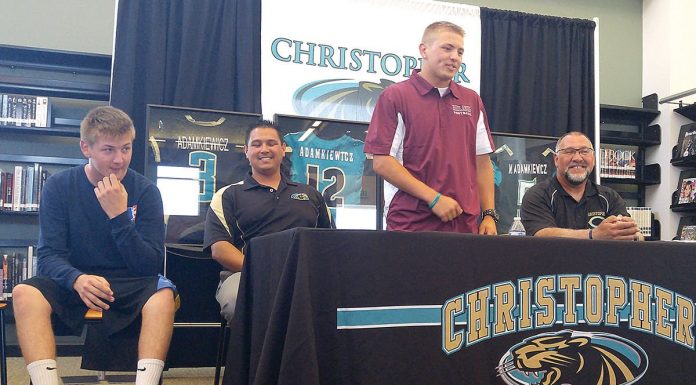
Coach Tim Pierleoni saw Matt Adamkiewicz throw a football in his PE class and knew he had to get the freshman onto his team and groom him to be a quarterback.