
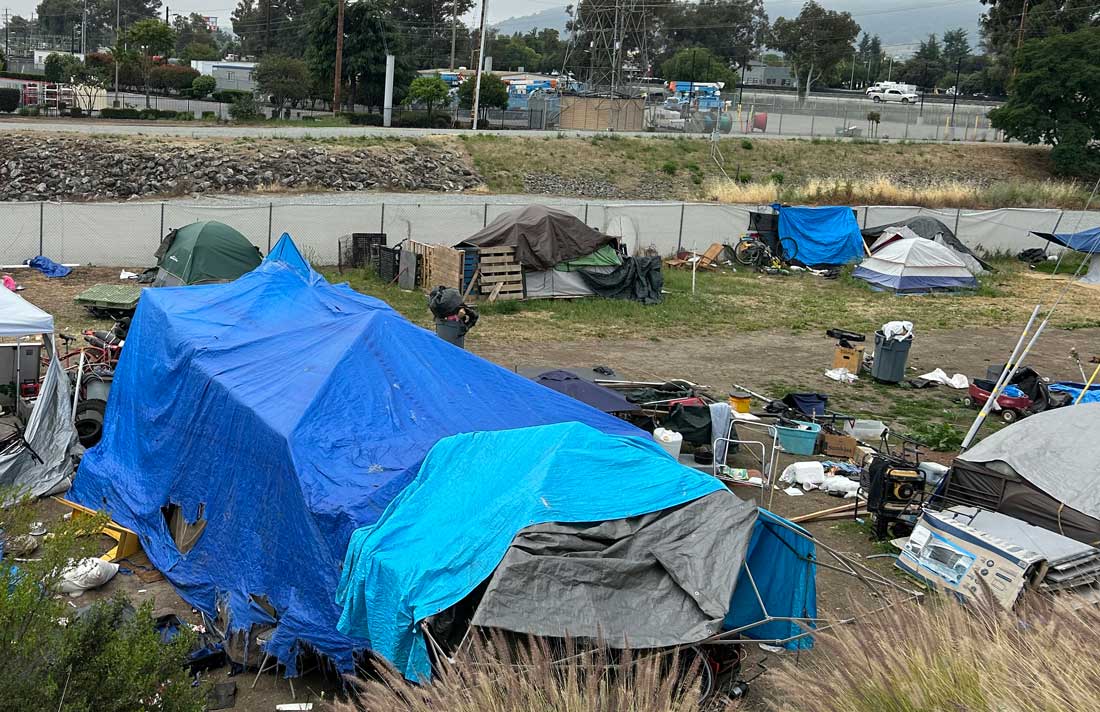
The Gilroy City Council narrowly voted to close down a homeless encampment on city-owned property by Dec. 15, at the same meeting where officials presented an update on ongoing efforts to establish a permanent encampment or transitional residence for unhoused people looking for long-term shelter.
At the end of the Nov. 2 meeting, the council voted 4-3 to shut down the camp, known as “Camp Hope,” at East Sixth Street and Camino Arroyo Drive. The council’s decision will evict about 20 residents of the camp, which is located on the east side of Highway 101 and across a flood control channel from Costco.
Mayor Greg Bozzo and Councilmembers Dion Bracco and Kelly Ramirez voted against the motion to close down Camp Hope.
Since the camp formed earlier this year, the city and partner organizations have provided services including outreach, sanitation, portable toilets and connections to social services in the area. Residents of Camp Hope had previously lived in tents and temporary shelters at various properties throughout Gilroy, from which they have been successively evicted.
Gilroy City Administrator Matt Morley said two recent cleanup projects at Camp Hope cost the city about $20,000.
The camp is technically in violation of an ordinance passed in 2023 that prohibits camping on public rights-of-way in Gilroy. City officials have declined to enforce the ordinance at the Camp Hope property.
Councilmembers supporting the eviction of the camp said it’s unfair that the city is cracking down on camping on other public properties while allowing Camp Hope residents an exception to the law.
“If we want to look at changing a law then let’s look at changing the law. But applying the law to the majority and carving it out for a few is something that doesn’t sit well with me,” Councilmember Zach Hilton said.
Bracco suggested closing the camp will only disperse its residents to other parts of Gilroy, leaving the city with the same problems but more scattered.
“If you can’t support (Camp Hope), what’s your solution? Throw them out? Run them down the sidewalk? They’ve got to go somewhere,” Bracco said. “If you’re going to throw them out in the street, come up with some kind of solution.”
Committee on homelessness plans more work
An attempt at a long-term solution was discussed earlier in the Nov. 2 meeting, as members of a temporary or “ad hoc” committee on homelessness in Gilroy provided an update on their efforts.
The committee was formed in June and is composed of Mayor Greg Bozzo, Councilmembers Kelly Ramirez and Bracco, and a list of community members who represent Gilroy’s business and nonprofit sectors, as well as people who have experienced homelessness.
Morley said the committee, which has met six times since June, has been supported by a grant from Destination: Home. The committee’s work included discussions with officials from other cities that have dedicated considerable resources to addressing homelessness, including the Cities of Napa, Tulare and San Jose.
The committee’s efforts led to a short list of preferred outcomes for Gilroy, including a designated site for a homeless encampment with “rules and regulations for access, no tolerance for camping outside the designated space, opportunities for service providers, showers, restrooms—typical things the homeless might need,” Morley explained.
Such an encampment would ideally provide a “stable location” for people to stay while they search for long-term housing, Bozzo added. He said other cities, such as Auburn and Tulare, have seen success with similar programs.
The City of Tulare manages a two-acre encampment with up to 150 camp sites with hygiene and sanitation services, all overseen by city staff, according to a Gilroy city staff report.
“Tulare’s experience reinforced the pattern seen elsewhere: clear rules reviewed with every resident before entry, a camping ban that reinforced participation, and direct city ownership of the site together produced measurable results, including a drop in calls for service from 192 to 38 in the program’s first nine months and the eventual closure of the original encampment that had prompted the program,” says the staff report.
But some councilmembers said they would like to see more details about how Gilroy can reach a similar outcome. Others at the meeting noted that Gilroy and Tulare are considerably different in terms of population and cost of living.
A new full-time Gilroy city staff position focusing on homelessness issues might be necessary, for example, but some officials wondered how the city could afford that.
Bozzo said the committee would return to the full council with a “business plan” and more details for a homeless encampment concept.
Gilroy resident and ad hoc committee member Vanessa Ashford, speaking during the Nov. 2 meeting’s public comment period, noted that cities that have successfully helped their unhoused populations have a number of things in common.
“They invest in dedicated leadership (such as) a designated staff person whose responsibility is to coordinate the city’s response, build partnerships, identify funding opportunities, pursue grants and ensure efforts are going forward,” Ashford said. “They recognise that people with lived experience should be part of the solution, and not as an afterthought.”
By the numbers
The Gilroy City Council’s ad hoc committee on homelessness presented the following numbers on the local unhoused population and how it impacts the community, among other data:
275: Gilroy households assisted by South County Community Services in the past year.
16.9%: Households that received rental assistance in the past year.
$875,000: Gilroy’s current annual cost for homeless services, including police and community development staff responses.